TURNING ENGINEERING
IDEAS INTO HARDWARE.
Currently enrolled as an Aerospace Engineering major at Florida Institute of Technology working towards a B.S. with a concentration in Astronautics. Fascinated by rocket engines, precision manufacturing and hands-on hardware development from CAD through static fire and flight hardware.
Right Now
Current Focus
Right now I'm working the testing subsystem for SatDoc, our senior design satellite docking project. My focus is the GNC behind our Air-Bearing Vehicle, the team's primary testing apparatus, writing code for it and running pre-test analysis.
Archive
Featured Projects
Project Aurelian
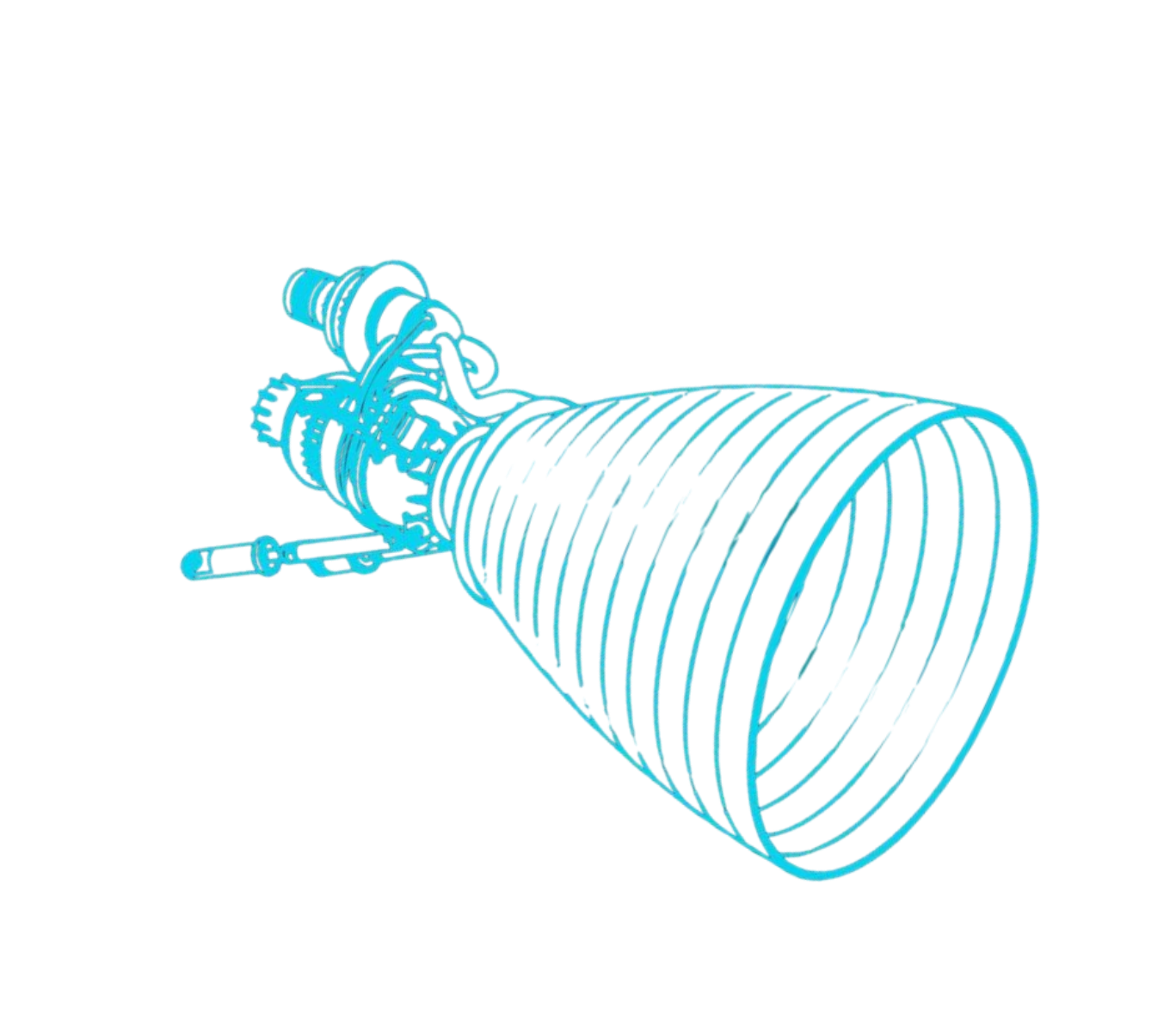
A bipropellant liquid rocket engine using nitrous oxide and E85 as propellants, based on Half Cat Rocketry's open-source Mojave Sphinx design. Built independently by a 6-person team as an introduction to liquid rocket engines, with a personal goal of bringing five friends without prior rocketry experience into the hobby. With all engine hardware machined, the team is now building out the testing infrastructure (data acquisition, test stand, and test documentation) before assembling the full system.
Open dossier →Phantom 10K
2" experimental solid rocket motor effort to achieve 10,000 ft, achieving 10,228 ft on the flight; the highest altitude that the club has ever achieved, the University's first experimental (homemade) motor build, and the first homemade motor flight.
Open dossier →L1 Certification Rocket
Vega 1 - modeled, built, and painted within a week. Flown to a simulation apogee of 3,000 ft. Mach 0.766. Successfully recovered.
Open dossier →Moon Colony Logistics Modeling
An independent, award-winning, student-driven research study modeling the logistics of moving 100 million metric tons of infrastructure to the Moon, contrasting super-heavy rockets against a hypothetical space elevator through stochastic jump-diffusion.
Open dossier →Machining
One year experience in machining using manual mills and lathes as well as a 4-axis HAAS TM3P and 2-axis CNC mills and lathes working on propulsion hardware, such as CNC machining nozzles and nose cone tips for Phantom 10K, and manual/CNC lathe machining of SABER, which is a bipropellant engine being developed by a senior design team.
Open dossier →Laser Cutting & Engraving
Hands-on work with fiber and CO2 lasers, starting from setting up engraving parameters on metal and wooden materials in the test grids through to creating completed engraved artwork.
Open dossier →Waterjet Parts
Three items have been made from aluminum water jet cut pieces. The monogram was designed as the personal piece, the second was a motor retainer for Vega 1 (L1 Build), and the third item was designed as a test piece for bulkhead fabrication, which would allow evaluating the feasibility of using water jet cutting for manufacturing fuel/oxidizer bulkheads in future.
Open dossier →Reaction-Role Discord Bot
A Discord bot for the Society of Math Students server that allows members to assign themselves to roles corresponding to their courses by reacting to a message.
Open dossier →DeltaUnits: NX Unit Converter
Lightweight Windows tool that will convert Siemens NX .prt files from millimeters to inches and vice versa within one click, packaging Siemens NX unit converter into a convenient GUI interface.
Open dossier →School Projects
Selection of some notable coursework projects from Florida Tech featuring a minimum length 2D rocket nozzle design through the Method of Characteristics and ball and beam controller design.
Open dossier →Particle Bed Reactor Simulation
Particle bed reactors are among the most compact and highest-performing nuclear thermal propulsion concepts for crewed Mars missions, but their fuel beds are vulnerable to a thermal-hydraulic instability in which a locally hot region loses coolant flow and overheats. Whether the porous cold frit surrounding the bed prevents this has been an open question since a 1993 NASA analysis called for calculations on specific designs. We developed FritCheck, a Python simulator that models a published particle bed fuel element as 20 coupled parallel flow paths, including the inlet plenum and exit channel, and tests flow stability with two independent methods. Using only published inputs and pass/fail criteria committed before any validation run, the simulator reproduced published pressure drops within 4-11% on two fuel elements, passing 7 of 8 Tier 1 checks. It showed that without a cold frit the element has no steady operating point above 1 MW/L, while with one it is stable at every power from 5% to 100%. A published optimized cold-frit design proved stable across the throttle range, but with only half to two-thirds of the original design’s stability margin, and it exceeded the 3800 K fuel limit at 20–22.5% throttle. Changing the flow pattern from Z to U cut flow nonuniformity fivefold and lowered peak fuel temperature by about 540 K. A machine-learning surrogate trained on 2,000 solver runs predicted outcomes over 100,000 times faster, but missed one in six failing designs, falling short of the pre-set accuracy standard. These results show that design optimizations for nuclear rocket fuel elements must be checked across the full operating range rather than at a single point, identify flow pattern as a powerful lever for reducing hot spots, and demonstrate a transparent, reproducible workflow for early-stage reactor design screening.
Open dossier →