High-Power Rocketry Certification
L1 Certification Rocket
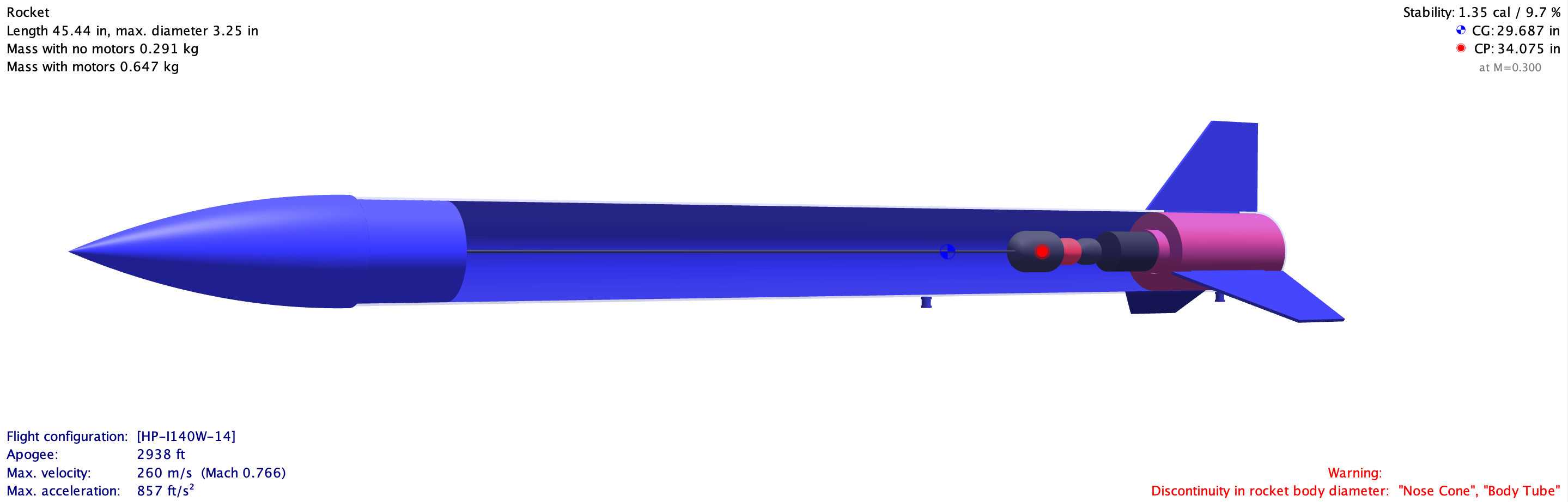
OpenRocket Model - Vega 1 airframe for L1 certification flight
Flight Parameters
Mass without motors
291 g
Mass with motors
647 g
Length & Diameter
45.44 in | 3.15 in
Stability margin
1.35 cal (9.7%) at M = 0.3
CG & CP
29.687 in | 34.075 in (at M = 0.3)
Predicted apogee
2938 ft
Max velocity
260 m/s (Mach 0.766)
Max acceleration
857 ft/s²
Mission
Design and launch a rocket that can safely carry an I-class L1 certification flight with adequate stability margin for flight and safely recover with minimal wear/damage.
Design Approach
Flight tests revealed a stability margin of 1.35 calibers (9.7%) at a center of gravity of 29.687 in and center of pressure of 34.075 in from the nose for Mach 0.3. This margin should provide ample stability throughout the flight.
Certification Path
Step 01 — Level 1
I Motor
The first certification flight will use an I140W motor and will act as the L1 certification flight and the test of the simulation flight profile.
Step 02 — Level 2
J Motor
My plan is to begin the design process for an L2 class rocket consisting of simple avionics, such as a camera or altimeter, to add a challenge to the design.
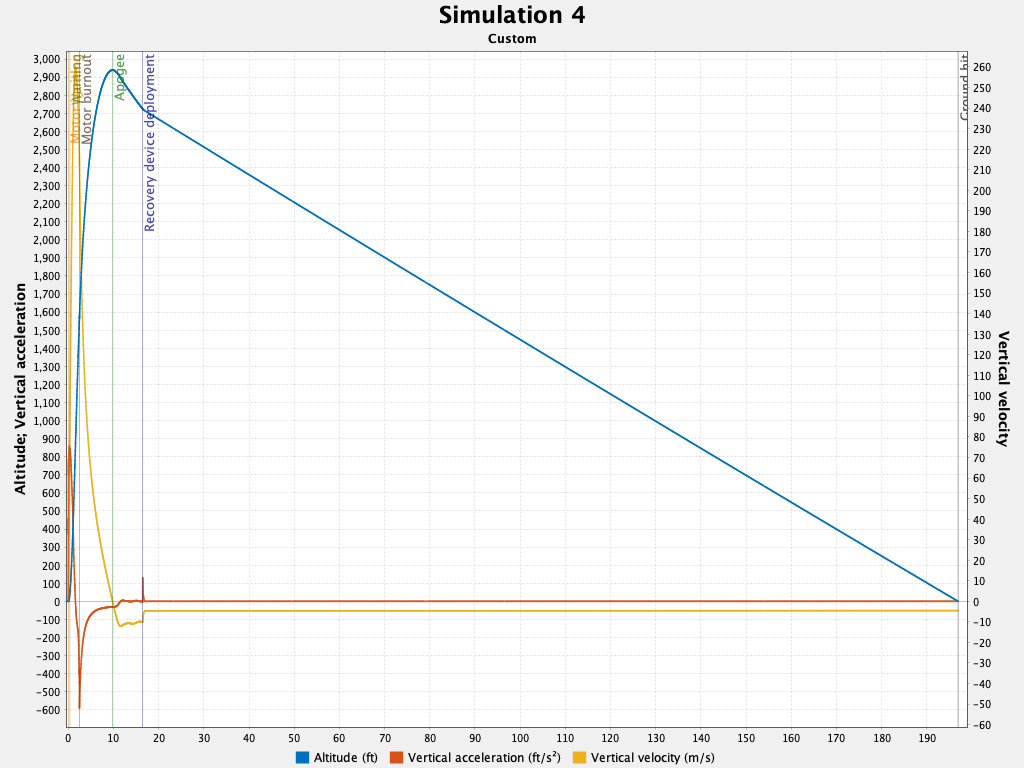
OpenRocket Simulation - Altitude, velocity, and acceleration vs. time for L1 flight
Manufacturing
However, from the outset, the airframe had been dimensioned and designed to be able to withstand the greater impulses as well as masses that result from the use of the J engine, despite the fact that the initial flight uses an I engine for L1, in the event an L2 rocket would like to be launched utilizing the Vega 1 airframe.
Reflection
"Post flight recovery was harder than expected; finding a rocket in a thick brush, no matter if you see where it lands, poses a large challenge. Weather is unpredictable, and a scrubbed launch is not uncommon."
Skills Learned