Independent Applied Math Research
Moon Colony Logistics Modeling
Abstract
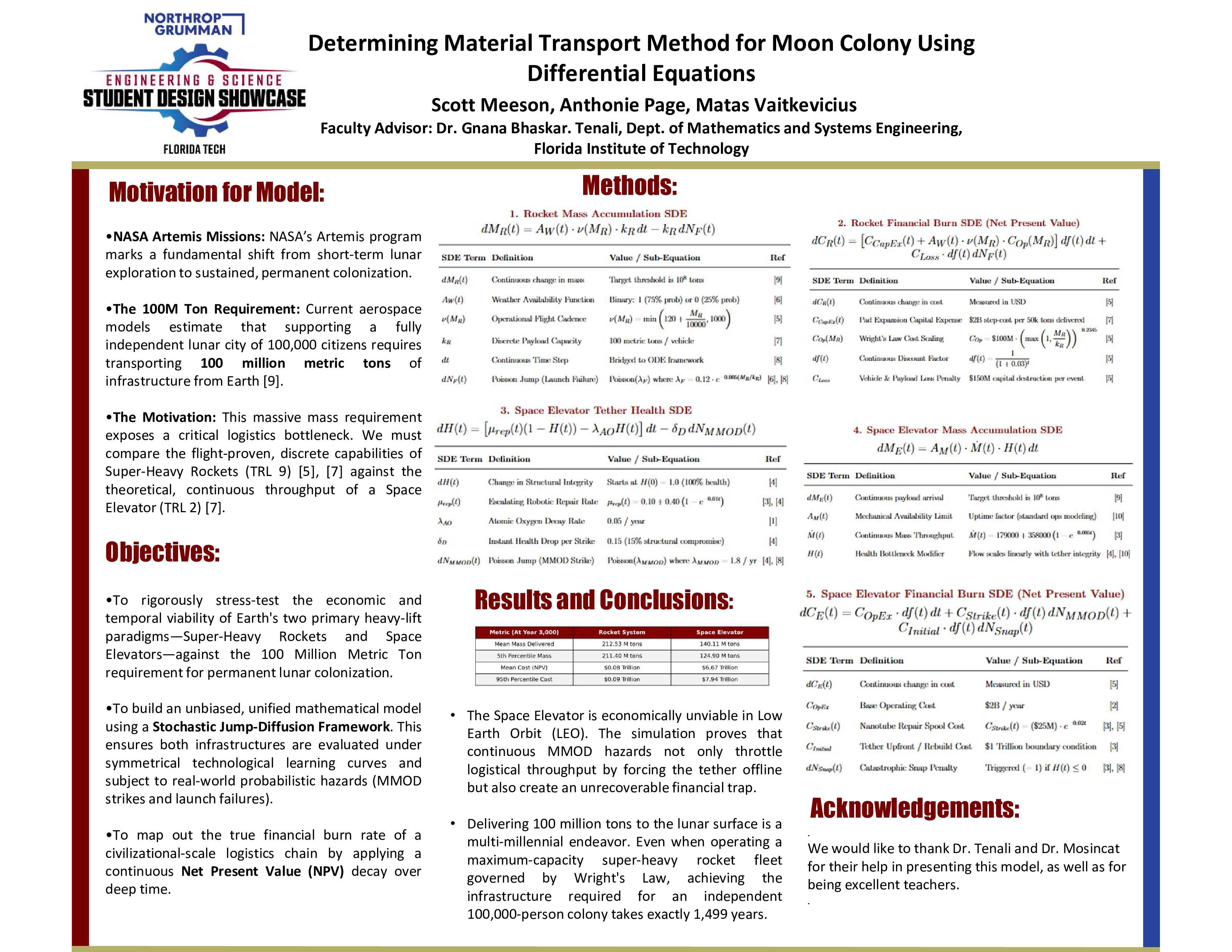
An independent, award-winning, student-driven research study modeling the logistics of moving 100 million metric tons of infrastructure to the Moon, contrasting super-heavy rockets against a hypothetical space elevator through stochastic jump-diffusion.
Motivation
Choose which of two infrastructures heavy-lift options will be better suitable for the delivery of the infrastructure necessary for the creation of a sustainable lunar colony of 100,000 people taking into account all the risks of launching failures and micrometeoroid/orbital debris (MMOD) attacks in reality.
Methodology
The model combined the dynamics of continuous differential equation for mass accumulation and financial burn with jumps via Poisson processes of hazards occurrence: launch failures for the rocket scenario, and MMOD strikes and catastrophic breaks of the tether for the space elevator scenario. The evaluation of the two concepts was done according to Wright's Law of cost scaling and continuous decay of net present value, thus allowing for an apples-to-apples comparison between the technologies at different technology readiness levels (one is TRL 9, the other is TRL 2).
Model Scope
- > Framework: stochastic jump-diffusion model (coupled SDEs)
- > Scope: mass accumulation, financial burn rate (NPV), and structural health, modeled for both transport methods
- > Hazards modeled: launch failure (Poisson process), MMOD strikes, tether structural decay
- > Baseline requirement: 100 million metric tons of delivered infrastructure
- > Deliverable: unbiased comparison under symmetrical technological learning curves
Findings
Space Elevator Findings
The simulations showed the idea of the space elevator to be economically non-viable in Low Earth Orbit; constant MMOD risks not only limited the throughput due to keeping the tether down but also led to a compounding economic loss without any way to get back.
Super-Heavy Rocket Findings
Even under the maximum capacity of super-heavy rockets, operating according to the cost improvement predicted by Wright's Law, it would have taken about 1,499 years to deliver all the necessary 100 million metric tons to build the colony.
Recognition
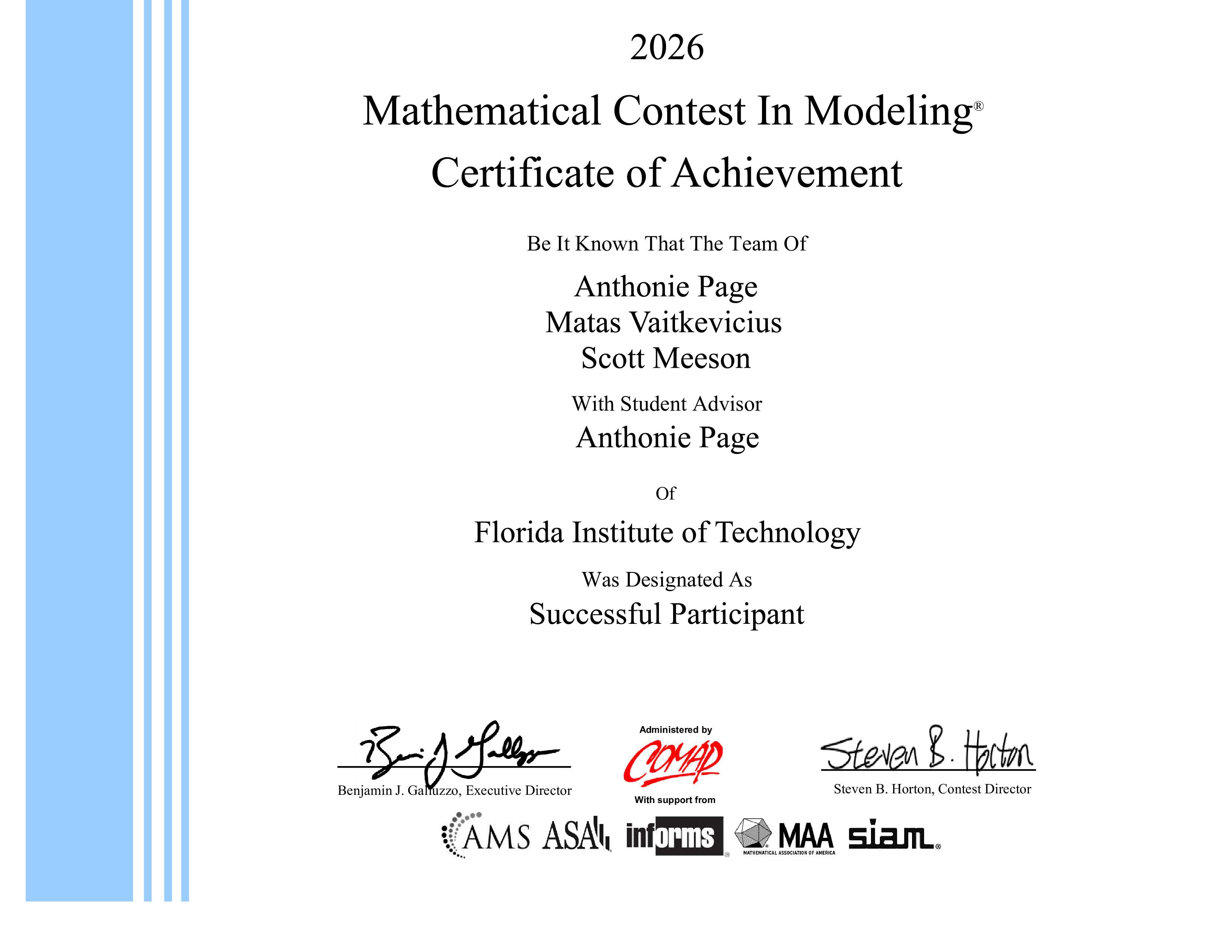
MCM 2026
Successful Participant
MAA FL / FTYCMA
Best Undergraduate Poster
Ospreys Mathematics Conference
Best Undergraduate Poster · 3rd Place Individual
Florida Tech Design Showcase
Final Presentation
Reflection
"Analyzing both transportation methods within the framework of the same probabilistic hazard model, rather than analyzing each of them individually, was what made it possible to recognize the financial trap that space elevator is; a simple deterministic comparison would fail to reveal how compounding risks affect a continuous flow system. This is my own research work, done independently of any faculty-led lab, through conference feedback during two competitions prior to the presentation at Florida Tech's Student Design Showcase."
Skills Learned